When exceptional results start excusing unacceptable behavior*
Case 26 04
Key Takeaways
- Exceptional results are sometimes used as an implicit excuse for overly tough behavior — often without conscious intent.
- What is tolerated early at senior levels quietly shapes culture and becomes increasingly hard to correct later.
- Leadership leverage grows when performance pressure is paired with visible respect and genuine listening.
- Softening the edges does not mean slowing down — it multiplies execution through others.
- Sustainable authority comes not from pushing harder, but from creating conditions in which others fully engage.
In many organizations, there is an unspoken deal: as long as the numbers are strong, a lot is tolerated. Sharp language. Impatience. Public pressure. People being overrun rather than listened to. The justification is familiar and often unquestioned: “Yes, he’s tough — but look at the results.”
For a while, this logic appears to work. Performance is delivered. Markets are defended. Targets are met. But beneath the surface, something else starts to shift. Trust erodes. Energy leaks out of the system. People become cautious rather than committed. And once that dynamic takes hold, it is remarkably difficult to reverse.
This case is about a senior executive who embodied that tension — and about what became possible once he stopped using performance as an excuse and started seeing leadership as leverage.
A highly successful leader — and a growing concern
The executive in question led a large, standalone division of a global industrial group. Commercially, the division was a success story: multi‑billion revenue, strong margins, and sustained performance in an increasingly competitive environment. From the outside, it looked like a textbook example of decisive leadership under pressure.
Inside the organization, however, the picture was more nuanced.
While the executive board appreciated the results, they were increasingly concerned about the internal dynamics. Frictions in the leadership team were becoming more visible. Tensions rippled through the organization. Collaboration felt brittle. The division worked — but it did not flow.
The concern was not a crisis. It was more subtle — and in many ways more dangerous. Because nothing was “broken enough” to force change. And because performance offered a convenient explanation for everything that felt uncomfortable.
“I know what’s coming — but let’s do it properly”
When a structured feedback and development process was proposed, the executive’s initial reaction was guarded. He had received feedback before. He knew his reputation. He also knew that he was demanding — and had long seen this as part of his effectiveness.
Yet something shifted when it became clear that this was not about labeling or judging him, but about offering an outside‑in view and creating space for reflection. He agreed — with a condition that revealed a lot about him: “If we do it, let’s do it properly. So, it actually helps — let’s not just tick a box.” With that he started to buy-in and we started a journey.
Ownership mattered deeply to him. Being reduced to the object of a process did not. He wanted to be involved, to understand, and to stay in the driver’s seat. Fair enough.
A leadership profile that felt uncomfortably familiar
We used the Leadership SCRUM methodology to capture structured 360° behavioral feedback that is translated into a scaled competence model. The aggregated feedback confirmed what many would have expected.
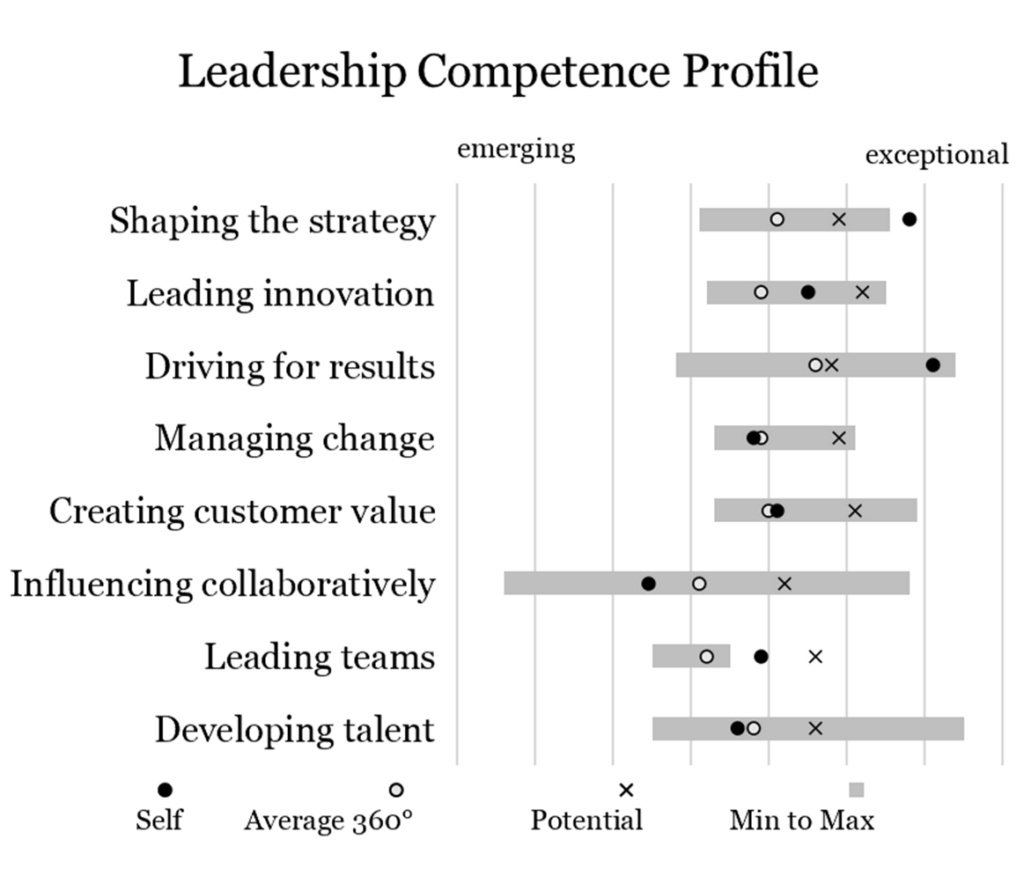
His profile showed a very strong emphasis on driving for results — a clear spike compared to other leadership dimensions. Execution, pressure, pace, and clarity were his natural strengths. This was how he had built his career, and he knew it.
Other areas — particularly influencing collaboratively and leading teams — were solid, but clearly less pronounced. Not weak. Not alarming. But noticeably secondary.
What caught his attention was not so much the scores themselves, but the spread of perceptions – especially in influencing collaboratively. Some people experienced his style as energizing and clear. Others experienced it as intimidating and dismissive. Both views existed at the same time — and that discrepancy became a key insight. Once he realized – and accepted – the spread, there was a second revelation: there was no spread leading teams. This was a question of honor to him: “I must do something differently!”
Interestingly, his self‑assessment mirrored this pattern. He was tougher on himself where he knew he was less strong — and overly confident where he felt firmly in control. Results mattered most. And he wanted them to show.
The moment the conversation could have ended — but didn’t
At this point, many such discussions stall. The logic would have been simple: “Yes, I’m tough — but it works. And the rest isn’t disastrous. So, let’s not overreact.” What he had not fully realized was that results had quietly shifted from being an outcome of leadership to becoming a justification for avoiding it.
He briefly flirted with that conclusion but then paused for a long time to come back and accept the challenge.
What made the difference was not a clever intervention or a persuasive argument. It was the realization that his results orientation had quietly become a justification. A shield against having to look more closely and an excuse to not change a winning set up that had served him so well in recent years. He was ambitious though and decided to invest in his own future.
And once he saw that, he was willing to stay in the conversation.
From competencies to behavior: where leverage really sits
Rather than debating abstract leadership qualities, the discussion shifted toward concrete behavior — small, visible actions that carried disproportionate impact.
The Leadership SCRUM analysis highlighted three behaviors with disproportionate leverage — a “Magic Triangle” for leadership growth. Needless to say, that these behaviors primarily paid into the softer competences that were not so pronounced:
First, showing respect for other views — not as a value statement, but as a lived behavior in meetings and decisions. He recognized that impatience often led him to interrupt, cut short, or move on too quickly. Not because he didn’t respect people — but because speed felt more important in the moment.
Second, making a genuine effort to understand people, beyond what was immediately required to get the task done. He realized that his interest in others was often instrumental. Efficient. Focused. And sometimes perceived as shallow.
Third, being more willing to compromise to gain real buy‑in. This triggered a laugh — and then a moment of honesty. “I want things my way,” he said. “And I probably step in too quickly. I interfere when I should enable.” He began to see that leadership leverage grows with the ability to create buy in — and, through it, ownership.
None of this was really new to him. What was new was seeing these behaviors not as “softening up,” but as multipliers.
There is no justification for bad behavior
At some point in the conversation, he said something that marked a clear shift: “There is no justification for bad behavior. Not even results.”
This was not a rehearsed insight. It emerged as he spoke — and listened to himself.
He began to articulate the downstream effects he had previously dismissed: people withdrawing, reducing ownership, holding back ideas. Not because they were incapable — but because they did not feel heard.
What changed was not his ambition. He still wanted to win. He still wanted speed. But he began to see that pressure without respect eventually slows things down.
From feedback to feedforward: let’s experiment!
The discussion gradually moved from reflection to experimentation.
He became interested in what would happen if he did more of certain behaviors — not less of others. This mattered to him. He did not want to be slowed down or softened in a way that felt like compromise. He changed his perspective from doing less of a bad thing to doing more of a good thing. This sounded appealing to him – after all, it meant raising the bar, not lowering it!
The idea that resonated most was simple: strengthening the team as leverage for even higher performance – a platform for himself to grow as a leader.
Listening more. Letting others finish. Allowing ideas to breathe. Holding back — selectively — where stepping in was not required.
Not as an act of restraint, but as a deliberate investment.
A different definition of strength
Toward the end of our sessions, the tone shifted noticeably. What started as a slightly defensive conversation had become forward‑looking and surprisingly light.
He spoke about wanting to role‑model this behavior for his direct reports. About casting a wider net beyond his trusted inner circle. About using diversity of thinking not as a concession, but as a competitive advantage.
And he summed it up in a way that stayed true to who he was:
“A racehorse needs to run. But even a racehorse needs the right track.”
* This case is a composite, inspired by multiple leadership journeys. Details have been altered to protect anonymity.