When others see your authority long before you see it yourself*
Case 26 06
Key Takeaways
- Leadership roles are not always claimed with confidence – some are accepted with hesitation and doubt.
- Impostor feelings often emerge not from weakness, but from high standards and a strong sense of responsibility.
- How others see us can be fundamentally different from how we see ourselves – especially at the top.
- License to lead is frequently granted by peers long before leaders allow themselves to accept it.
First-time CEOs vary in confidence
Some leaders step into senior roles with great confidence – sometimes too much. Others do the opposite. They hesitate. They doubt. They wait for a signal that may never explicitly come.
More than a hundred years ago, the journalist William Allen White famously described the role of journalism as “comforting the afflicted and afflicting the comfortable.” In leadership development, a similar pattern often appears. Some leaders need to be challenged in their certainty. Others need something very different: reassurance, permission, and clarity that they already have the right to lead.
This case is about a CEO who did not lack capability, experience, or credibility – but struggled to internalize his own authority. And about what changed once he realized that leadership is not only something you claim, but also something that is quietly granted by others.
A CEO who did not raise his hand
The client was a medium-sized professional services firm with a long history, strong reputation, and conservative culture. Commercially successful, well established, and proud of its traditions, the company had recently gone through a leadership transition.
The new CEO had been appointed from within. He was a respected expert, deeply familiar with the business, and trusted by many. Yet his appointment had not followed a classic pattern. He had not actively campaigned for the role. In fact, he had not raised his hand at all.
When he stepped into the position, he did so with a sense of duty rather than ambition. And with that came a quiet but persistent doubt: Was he really the right person?
Alongside him sat a younger executive board member – talented, ambitious, and visibly eager to move up. The contrast between the two was palpable. Where one hesitated, the other leaned forward.
The Chair sensed the tension early and asked for an outside-in view – not to replace anyone, but to stabilize the leadership team and to support the new CEO in finding his footing. However, this was framed as a team development exercise. The coaching for the CEO only resulted in a series of feedback and feedforward sessions.
Looking at leadership through others’ eyes
As part of the process, we worked with a tool called Leadership SCRUM to collect structured feedback from the Chair and from the executive board members on each other to include a self-assessment of all executive board members.
At first glance, the leadership competence profile of the CEO looked unspectacular. There were no dramatic peaks, no alarming gaps. A solid, balanced picture – neither exceptional nor disappointing.
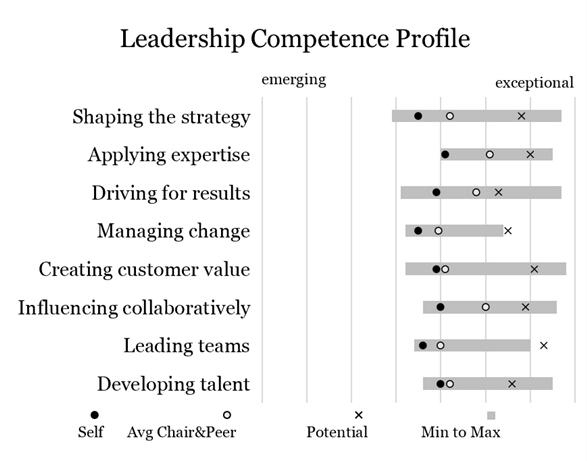
A closer look into the leadership competence profile revealed interesting findings.
Across all leadership dimensions, the CEO rated himself consistently lower than his peers and the Chair rated him. This was not a marginal difference. It was a pattern. Particularly in areas such as collaboration, working with expertise, and leading through substance, others saw him as significantly stronger than he saw himself. It should be noted that the Leadership SCRUM tool does not ask participants to rate these competencies directly; instead, it gathers behavioral input that is translated into scaled competencies. The peers and the Chair did not do him a deliberate favor but described demonstrated behaviors.
In other words: the people close to him trusted his leadership more than he trusted himself.
This contrast became the central moment of the feedback conversation.
“I thought they expected more from me”
For the CEO, seeing his self-assessment next to the peer feedback was deeply unsettling – and quietly relieving.
He had assumed that others were waiting for him to “step up,” to become more forceful, more visible, more assertive. Instead, the feedback suggested something else entirely: they already experienced him as a credible leader.
What surprised him most was not the positive assessment itself, but the tone behind it. The feedback was not about wanting him to be different. It was about wanting him to be more himself – and more confident in doing so.
Even the younger, ambitious board member expressed strong support. Not competition. Not impatience. But appreciation for the CEO’s way of leading.
This was the moment when the conversation shifted.
From development needs to recognition
Originally, the CEO had expected a classic development discussion: what to improve, what to change, what to fix.
Instead, the most powerful insight came from recognizing what was already there.
The behavioral themes emerging from the feedback were not calls for transformation. They were invitations to lean into encouragement, mentoring, and visible leadership presence. The organization did not ask him to become someone else. It asked him to fully inhabit the role he already held.
In particular, the leadership competence profile highlighted strong potential in developing talent and shaping the organization through expertise. These areas mattered deeply to him. Mentoring others, building credibility through substance, and positioning the firm through quality rather than volume were central to how he saw leadership.
What he had underestimated was that others already associated these strengths with him.
Accepting the license to lead
At some point in the discussion, the CEO paused and said something simple:
“So, they actually want me to lead!”
It was not a rhetorical statement. It was a realization paired with a certain relief, as if a burden had suddenly dropped from his shoulder.
Until then, he had treated leadership almost as a provisional assignment – something to be earned continuously, cautiously, and without presumption. The feedback made it clear that the organization had already granted him the license while he was still waiting for it.
This did not inflate his ego. On the contrary. It grounded him.
Accepting the license to lead did not mean becoming louder or more dominant. It meant allowing himself to act with more confidence, clarity, and presence – without second-guessing every move.
Leadership authority without overreach
One of the quieter but most important shifts was how he began to think about authority.
He did not need to compete with the ambitious board members. He did not need to prove his legitimacy through control or visibility. His authority rested elsewhere: in expertise, in collaboration, and in the trust others placed in him. All this felt natural to him.
Once he realized how much the requirements were in line with what he stood for, he could lead more calmly – and more decisively.
The irony was not lost on him: the more he trusted his right to lead, the less effort it required to assert it.
A different kind of strengthening
When the sessions ended, he was visibly lighter. Not euphoric – but sober and settled.
He did not leave with a long list of behavioral commitments or development goals. What he took with him was something more fundamental: reassurance, orientation, and confidence that his leadership was both wanted and working.
Over the following years, he continued successfully in the role before eventually moving on to a board position. The question of legitimacy never resurfaced in the same way.
Sometimes, strengthening a leader does not mean sharpening edges or pushing harder. Sometimes it means helping them see what others already see – and giving them permission to believe it.
* This case is a composite, inspired by multiple leadership journeys. Details have been changed to protect anonymity.